
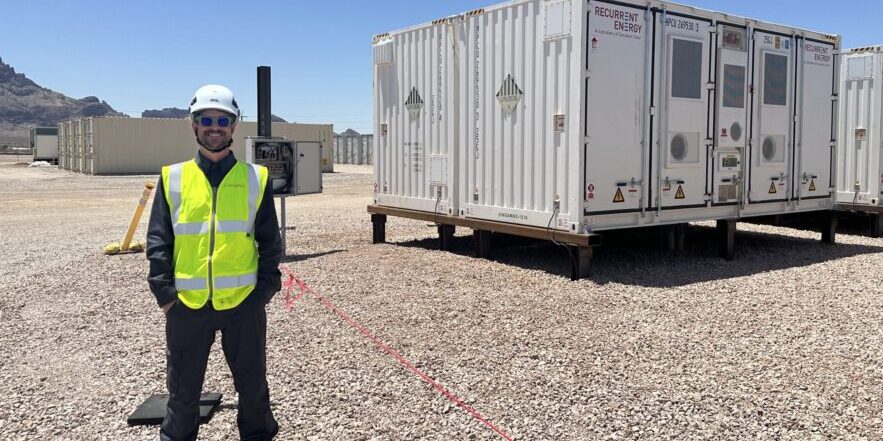
Joe Thompson IV has applied what he learned through his Penn State education to climate action across two states and three continents.
 Thompson graduated cum laude from Penn State in August 2024 with a Bachelor of Science in Energy and Sustainability Policy he completed online through Penn State World Campus. He came to Penn State as someone who wanted to become a sustainability professional, and he spent four years building the expertise and confidence to do work that he once considered out of reach.
He has not slowed down since.
Today, Thompson works as a commissioning coordinator for North America at e-STORAGE, supporting utility-scale battery energy storage projects across North America, South America, and the Asia-Pacific region. He also consults on local climate action planning, volunteers with his city’s sustainability committee, and serves on several boards as an active Penn State alumnus.
Read more about Thompson in the Q&A below.
Why did you choose to pursue a bachelor’s in energy and sustainability policy through Penn State World Campus?
COVID-19 brought the world to a halt, and for me, it offered time for reflection. I wanted to participate in sustainable development and climate action but lacked training and knowledge. My role at the time was unrelated to the field.
Desiring more for myself, I searched for online programs in sustainability that I could manage alongside my career. I found Penn State’s energy and sustainability policy (ESP) program. It sounded like the perfect choice, with the right amount of climate science combined with sustainability and energy policy. The Penn State College of Earth and Mineral Sciences offers this degree online through Penn State World Campus. It fit the goals I had for my future. I applied, was accepted, and the rest is history.
What project during your time as a student had the biggest impact on you?

Through the ESP program, I participated in the Local Climate Action Program (LCAP) with Doylestown Borough in Pennsylvania. LCAP is a Penn State–led initiative that gives students a chance to apply what they have learned about sustainability to recommend solutions to municipal officials in Pennsylvania that they could implement.
The Local Climate Action Program demands a lot from its participants, and it also has the power to transform personal and professional aspirations. It taught me real-world skills in public speaking, creating presentations and formal public-facing reports, how to inventory a community’s greenhouse gases, and how to create change through thoughtful action rooted in science. I had the opportunity to speak to officials from Mechanicsburg Borough in Cumberland County, Pennsylvania, about the program and how it helped me grow as a leader and a professional in the world of climate action. They joined the program the following year.
The skills and lessons I gained through hard work, perseverance, and a positive attitude shaped me as a person, a leader, and a professional. It gave a hopeless soul agency and the power to craft change.
What does your life look like now after graduation?
After graduation, my life took an exciting new direction. Keeping the spirit of my programs in energy and sustainability policy and energy business and finance alive, I am applying my passion for these fields and the experiences I gained at Penn State to my community.
 I accepted a full-time position as a commissioning coordinator at e-STORAGE, where I support utility-scale battery energy storage systems across North America, South America, and the Asia-Pacific region. These projects supply thousands of residents with clean energy and are helping transform how the grid meets our energy needs. I recently visited one of our projects outside Phoenix, Arizona: a 300-megawatt site that supplements the grid for Arizona Public Service. On my flight from Orange County to Phoenix, I looked out the plane window and realized I was looking at the very project I would visit the next day.
For me, seeing it run and walking the site reaffirmed what I do and the importance of this type and scale of renewable energy project.
How has your experience empowered you to make a difference in your community?
I became a strong, resilient, and capable leader. I brought my Local Climate Action Program experience back to my hometown in California, consulting with university students to build sustainability plans for local governments. This volunteer work is very rewarding.
Penn State gave me so much. It makes me excited to continue using my experience to guide others and create positive change in communities. The impact has reached a number of places:
- Doylestown Borough, Pennsylvania — Through the LCAP, I identified the three largest sources of emissions in the borough: transportation, commercial and industrial energy, and residential energy. I presented findings that are being considered as officials update the borough’s climate-friendly comprehensive plan.
- City of Orange, California — As a volunteer consultant with the Orange Sustainability Committee, I worked with 17 environmental science and policy students at Chapman University to produce the city’s first greenhouse gas inventory and climate action plan. The plan was presented to an enthusiastic city council in May 2024 and is now in the funding stage.
- Brea, California — Consulted on sustainability plan format and content and assisted with research on urban-wildland interface and wildfire threats.
- Orange County — Participating as co-guide with Cool OC and the California Air Resources Board in an Aclima air quality monitoring initiative, measuring pollutants in marginalized communities across central Orange County, including my own hometown.
- e-STORAGE, North America — Supporting utility-scale battery energy storage projects that decrease emissions from power production and supplement solar farms across the continent.
- Sunnova Energy Corporation — As lead interconnection coordinator, I managed approvals for more than 1,000 customers across 40 states and 80-plus utilities for residential solar and battery storage projects.
Cleaner air. More walkable downtowns. Lower energy bills after efficiency upgrades. More transportation options. Better health and quality of life. These are things I strive to bring to my communities to make them resilient, strong, and healthy in the face of a changing world.
What does it mean to you to be a Penn State alumnus who is actively making a difference?
I matured greatly over those four years and became the type of leader I never thought I could become. I am happy and cannot wait to continue using my Penn State experience to guide others and create positive change in communities.
I also learned invaluable time management skills that I use in my work and life today. The ability to work full-time, have hobbies and a life, while pursuing higher education, was a highlight of my adult life.
As a Penn State Alumni Association Young Alumni Ambassador for 2025–26 and vice chair of the LCAP Alumni Board, I am working to expand the program and continue supporting both students and communities. I am also preparing to sit for the Urban Greenhouse Gas Inventory Specialist certification exam to further deepen my expertise in climate action planning. I am also serving on the Graduates of Earth and Mineral Sciences (GEMS) Alumni Society Board.
Being a Penn State student was amazing. Being an alumnus who makes a difference is even better.
This Q&A is part of “40k alumni: 40 stories celebrating 40,000 graduates,” a series marking the milestone of more than 40,000 Penn Staters earning their degrees online through Penn State World Campus.